Thursday, September 11, 2014

The Untold Plates


It’s been almost 9 months since the LDS History Dept released the topic essay on the Book of Mormon Translation, in which they admit that "Joseph placed the seer stone in a hat, pressed his face into the hat to block out extraneous light, and read aloud the English words that appeared on the instrument."   I joked at the time that God made “Reformed English” appear from the “Reformed Egytpian” written on the plates because the original manuscript was so chock-a-block with mistakes (4000+) that God needs remedial lessons in the English language.  

Little did I know that Daniel C Peterson would take that “Reformed English” idea so serious.  Peterson  claimed and quoted others that the Book of Mormon doesn’t use “the Modern English that we typically use today… It clearly draws on a wide array of … language forms and syntax from the Early Modern English period, some of them obscure and inaccessible to virtually everyone 200 years ago.” And, "The original English Book of Mormon is... “in large part” an Early Modern English text, “even reaching back in time to the transition period” from late Middle English into Early Modern English."

Apparently there is growing consensus in what critics have been claiming for decades:  The gold plates were not needed at all to produce the Early Modern (or late Middle) English text of the Book of Mormon.  It all appeared in a vision (or the mind) of Joseph Smith when he stared into darkness. Amazing? Probably not as much as Peterson would like.

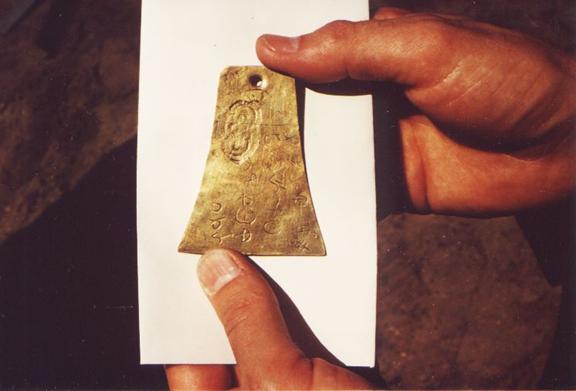
Still Will Hamblin, another regarded LDS Apologist, released photos on his blog recently showing gold plates that existed in ancient Italy (ca. 2500 years ago) that resemble the descriptions Joseph Smith gave. 


Witnesses, Smith’s wife and a few others still contended that there were actual plates, even if Smith did not need them proximate to envision the Book of Mormon words floating inside a hat.  

So, were there plates or not? 

Some thoughtful analysis says no way, because gold plates of the size he claimed would have weighed perhaps over 100 lbs--enough that his story of running with them under arm, fending off would be thieves, could not have happen. 

Apologists have re-countered saying that the plates were not pure gold, just golden in appearance.  They find in South America evidence that Amerindians worked in a gold alloy called Tumbaga, which is primarily copper with some gold mixed in.  

Other critics believe Joseph Smith made mock plates, perhaps of tin, because he wasn't rich enough to own any gold.  Let’s assess the data…
  
If the plates actually existed, then they weighed around 50-60lbs according to those that hefted them (in the box or under cloth). The dimensions that "witnesses" offer of the box or the plates under the cloth, of 6x8x6 inches (or just under 300 cubic inches in volume).  The plates were about as thin as "common tin" or ~0.5-1mm thick. See this wiki entry.  Apologists agree with these values.  (See https://www.lds.org/ensign/1986/12/i-have-a-question  for example.)

If these are accepted, then pure gold plates would have a weight of between 100-210lbs (the upper weight if the volume were pure gold without spaces), more than double what witnesses claim.  (The calculation is based on gold's density of 0.7 lbs/cubed-inch X 300 cubed-inches ~= 210lbs solid mass, and 100 lbs for 50% empty space.)

Critics have contended that if he had actual plates (a big question) they were likely tin, because that would be financially accessible and workable by frontier folk like Smith.  http://www.utlm.org/newsletters/no105.htm

I doubt either gold or tin.  Tin is not the right color. Though, it has a density of 0.26 lbs/cubed-inch and as such would have a volume weight for the plates around 40-80lbs.  Tumbaga, as apologists claim, of mostly copper would fit the story if the plates had been from ancient American sources.  Still, copper is about the right weight, with a density of 0.32 lbs/cubed-inch giving it a volume weight of around 50-90lbs.

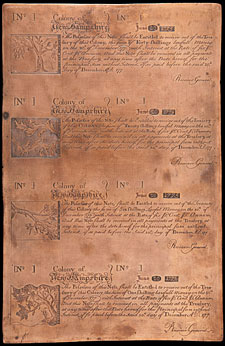
My proposal is that IF the plates ever existed, we can assume that Smith simply thought of a book, but knowing paper couldn't endure thousands of years, proposed the ear-catching golden plates.  And he could have easily made a forgery set of plates from brass-plated copper.  It would be cheap, engravable, the correct weight and gold in color.  Copper plates were used regularly (and for hundreds of years before Smith) by printshops. Most cheap copper plates were right around 1mm thick, though some expensive ones are thicker. Copper printing plateswere tossed away or re-used.  Plates the size of a book page (6x8 inches) would be quite accessible in the bins outside a printshop.   


Historical copper plate

The only problem is, copper is not gold in color.  That is easily remedied by brass-plating them, which even a novice apprentice-blacksmith could do simply using zinc powder and lye (sodium hydroxide).  This trick is done in elementary school science classes, using pennies.  

  
Interestingly, Oliver Cowdery had apprenticed as a blacksmith and was adequately good at it before turning to teaching.  See the 1890 (google scanned) book History of Utah: 1540-1886 By Hubert Howe Bancroft, Alfred Bates


Also this 1884 book.  


And this 1913 book.


Once you have gold-colored plates, all that was needed was to scratch some "caractors" (characters that may have come from the Detroit manuscript with latin short-hand script) into the surface of the plates (engraving copper plates are made just for that purpose).


One can also imagine that it's far too much work to scratch a whole novel of made-up "caractors" into dozens of plates.  Used printer plates would have engravings on at least one side and it would be apparent what they were on very close inspection.  Cursory glances of a few unused blank plates ontop and used plates under them would suffice to "prove" the claims Smith made.  The rest of the throw-away printer-engraven plates could be fastened together in a sealed portion, to make it look much more involved and real, without the risk of exposing the trick.  Hence the sealed portion. And the reason the plates were not needed for translation, nor allowed to be seen except by a few witnesses who were family and already believers. 

Of course, even at 50-60lbs, running with these fabricated plates would still prove very challenging, as exhibited by this fun test.  https://www.youtube.com/watch?v=08wRRff8x0k

The LDS History dept and apologists are the ones who are running with a heavy burden.  They are burdened with an antiquated story full of holes about the founding of their religious organization.  The Apostles are out of breath, Running with the Olden Plates


Interestingly, Joseph Smith may have conned others with forged plates, but he himself was conned with other forged plates.  These are the famed Kinderhook plates, which scientist analyzed and found to be 19th century forgeries.  Plate forgery in the mid 19th century was easy enough and fooled many, at least good enough to trick the LDS church into the 20th century (~1980).  Faithful frontier witnesses of plates surely were as gullible.
Sunday, September 7, 2014

Solely a Psychopathic Corporation

In the late 19th century the US supreme court was asked to apply the 14th Amendment to corporations and define them as individuals with all the same rights individual persons have. The court agreed. It was but a few decades later that the LDS church transitioned from a nominal corporation to a Corporation Sole. (See this for the official registry.  )

I detailed the LDS corporation sole in a very early blog including how it might end up dissolving. (See this blog.)

Under a common definition, a corporation sole consists of one person only, and the successors of that person in some particular station or office. (See this definition.)


The LDS corporation is treated not only like an individual under US law, but is actually literally an individual (as held by its office of President).


So, if the LDS corporation sole is legally and to some degree literally an individual with all the rights, issues and factors of other individuals, I wondered...

... Shouldn't the "individual" be tested for mental disorders, such as psychopathy?

I want to make it very clear-- First, I am not evaluating whether members of the church are psychopaths. Not at all.  The members are generally good-hearted, hard-working, loving people caught in a corporate sole that is, I opine, the opposite. Second, I realize psychologists would not like this, but I find it educational to consider something outside the box. While the LDS Corporation may not be a single mind (despite being a sole-owned corporation of the prophet), if legally it can be considered equivalent to an individual then it could be assessed as such for interest. I admit I am an amateur here, just stretching the analysis.

So how does the LDS Corporation Sole stack up?

One of the most accepted psychopathy checklists is the Hare list.(see the Hare list here. )


The primary list of Factor 1 on Hare's criteria is summarized as "Aggressive narcissism" and includes:


1- Glibness/superficial charm

2- Grandiose sense of self-worth
3- Pathological lying
4- Cunning/manipulative
5- Lack of remorse or guilt
6- Shallow affect (genuine emotion is short-lived and egocentric)
7- Callousness; lack of empathy
8- Failure to accept responsibility for own actions


In my estimation, the LDS corporation rarely if ever issues an "apology" or admission of error, even lying/covering up to hide their issues (Hare factors 3,5 & 8).  Even when issuing an essay about how the LDS church practiced racism for over 130 years, well past the US civil rights acts, they couldn't take full responsibility.  Not once has the LDS Church issued a single apology to those they banned from their priesthood, saying instead that they don't precisely know why, how, or when this racism  began but they are glad it ended decades ago. 

When members approach LDS scholars with  their doubts, they are often chided for not having learned beyond the correlated lessons of structured church organizations.  They are told that had they done their homework, they would have known the answers to their doubts.  This blaming the doubter is turning into attacking the questioner, and is classic fulfillment of Hare factors 3 & 8.

If that arrogance isn't enough, they believe they are the one and only true organization from the supreme intelligence (Hare factors 1 & 2). Monson, their current sole-owner prophet, feels so elite that he decried "so-called science" to belittle evolution and cosmology which counters his "truth" of a literal creation. Russel M Nelson, heart surgeon and apostle, glibly said of the human body, '
some people erroneously think that these marvelous physical attributes happened by chance or resulted from a big bang somewhere. Ask yourself, “Could an explosion in a printing shop produce a dictionary?” ' This is a strawman argument said from extreme pride to counter science.

They use tactics which are prototypical manipulations of individuals and of the public (one face for the media, another for members) (Hare factors 4 & 6).  Apostle Dallin Oaks, a former judge who understands the ethics of tampering with witnesses through manipulation, applies these very abusive practices in his general conference talks. (see * below for examples).  


The LDS Church hits the mark on Hare factors 6 & 7.  While they speak of empathy and charity, they give far less than even for-profit Target corporation to humanitarian aid.  Their words call for love, but their policies show no empathy.  They divide families against each other, and ensure through their temple requirements that worthy members denounce and do not associate with family who have doubts or have left the church.  They have used electroshock aversion therapies at BYU with gays.  In fact they brag that they expect, in the words of Joseph Smith, that as the one-and-only true church with the power to save others, the organization must "require the sacrifice of all things" from its members.  They will require tithing from impoverished members who can't afford to pay rent.  All while the corporation sole won't sacrifice profits behind billion-dollar malls, their Polynesian theme parks and the up-coming Philly 32-story condo highrise.


There is little to no correcting mechanism at LDS Inc that isn't completely outside the member's purvey. You can't vote, you can't have a union, you can't disagree. The leaders with that much power, love having that much power. It's all about power and control of people and money.


Factor 2 of Hare's criteria, includes:

  • Parasitic lifestyle (LDS church living off the member's donations and service)
  • Irresponsibility (not owning up to its behavior that ruins the lives of others)
  • Criminal versatility (well...perhaps one day we will have the evidence)


Summing up, LDS inc as a corporation individual would indeed classify positive under at least Factor 1 of the Hare list for psychopathy.


The LDS church skulking in 
the shadows of psychological abuse


* Dallin Oaks quotes showing psychological manipulation and abuse, include as some examples in one talk alone:
  • Insufficient Justification effect (psychological brainwashing) -- "We gain or strengthen a testimony by bearing it. Someone even suggested that some testimonies are better gained on the feet bearing them than on the knees praying for them."
    • Stereotyping and judgementalism (i.e., atheist are insincere, unlike believers)  -- "Though some profess atheism, there are many who are open to additional truths about God. To these sincere seekers, we need to affirm the existence of God."
      • Ego identity bias and brainwashing -- "We should also strengthen our children by encouraging them to define themselves by their growing testimonies."
        • Encouraging victimhood over mere disagreement -- "When he was persecuted for telling people about his vision, he likened his circumstance to the Apostle Paul, who was ridiculed and reviled ... We live in a time when some misrepresent the beliefs of those they call Mormons and even revile us because of them."


        Monday, September 1, 2014

        Ignorance Catastrophe


        Rise of the internet has led to a number of books, speeches and proclamations that there is an End of Faith, Modern Apostasy, Crucible of Doubt, and many versions of faith crisis” all around.  The phrase faith crisis is probably the most commonly used to express a concern that a lot of people currently face doubts about their faith (or their family religion) after viewing contrary information online.  Almost all world religions face this so-called crisis lately, mostly because the internet has made available vast libraries, history and discussions amongst doubters to members of almost all modern religions (those which have not been successful in shutting out the internet from their patrons).

        But what, really, is a faith crisis? 

        Let’s take the definitions.  Faith, in the religious context, is strong belief in God or in the doctrines of a religion, based on inward (spiritual) apprehension rather than external evidence.  In fact, most Christians and Mormons define it as “hope for things which are not seen, which are true.” And how do they know it is not true if it is not seen or measured in some valid manner?  They rely on inward belief of what they feel inside is true.  They cannot have evidence and call it faith, “for if a man knoweth a thing he hath no cause to believe, for he knoweth it.” (Alma 32:18)  

        In fact, LDS prophets speak frequently about keeping the faith and enduring to the end.  As one BYU professor explained it: 
        “I strongly suspect that this is exactly where the evidentiary situation is divinely intended to remain, pending Judgment Day. If the evidence for those claims were as conclusive as a proof in geometry, no meaningful intellectual freedom would remain to us.”

        Never mind how ridiculous are his thoughts on "intellectual freedom", clergy say that without faith there would be no test, and the plan of God would be frustrated.  Because faith is the first principle of most churches, then lacking evidence is necessary to God’s plan.  

        I want to explain that in another way so it’s clear what we’re reading. Let me use arithmetic:   
        Faith = no evidence + belief
        AND,  No evidence = no facts  
        ALSO,  No facts = ignorance  

        THUS, by the associative law our final answer is:  
        Faith = ignorance + belief.

        Now onto the second word of the phrase: Crisis.  By definition, a crisis is a time of intense difficulty.  A synonym is Catastrophe, such that:

         Faith Crisis = Ignorance Catastrophe.

        I understand that the people raising the alarm of a faith crisis will not like my equating it to an Ignorance Catastrophe.  Is it a catastrophe?  Yes, for those in the faith business, it really is. Their bread and butter of tithing, devotion, voluntary hours, praise, adoration, book sells and more are threatened by diminishing ignorance as the internet floods their members with actual facts and rational thinking.  The ignorance smashing has reached such a level it is looking to them like a crisis or a catastrophe.

        How dare others remove the ignorance of their members and cause these difficulties in their power position within the religions?

        On the other hand, expats of the faith industry are enjoy the opposite of a catastrophe, once they work through their own religious self-identity crisis[1].   Former members of most religions enjoy extra time, extra money, more freedom of choice, and less guilt about not believing or following rituals on ignorance.  They’re not having a faith crisis anymore.  Quite the opposite, they are often having a fact advantage or even a knowledge breakthrough.

        Sure some people live in such conditions of poverty or depression that they need to feel a higher power has a plan for them.  Yes, we all enjoy a social network and community like those found within religions. But why must the impoverished and depressed be subjected to so much guilt, tithing and hours of praising leaders and God in order to get a lift out of that depression or have a social community?  Is ignorance+belief really the most effective “crutch” we can come up with?  The LDS corporation has probably over $60 Billion in assets and liquid cash on hand.  How are they really helping the impoverished and depressed in ways found in a true charity devoted to helping the despairing among us?

        If religions were to actually sit down with the ex-members who’ve left, would they find most of them with their lives in crisis?  Well, they might if they’re a cult and they caused the crisis by pitting other members and even the family of that “faithless” ex-member against them.  How can I be sure?  I can’t be absolutely sure in every case but if you look at examples of people the world over without faith, religion or mystical belief and compare them to those with high degree of faith and belief, you won’t find the non-believers in any bigger crisis or life problems. Except, perhaps, for the prejudice against atheist that believers have.

        The faith crisis is not a crisis that most ex-members believe in.  They have personal evidence against this so-called crisis; evidence they can count directly in their increased bank account, their higher number of free hours, their lower need for anti-depression meds and more.

        The evidence tells us that the Ignorance Catastrophe only truly affects those who believe in it.


        In the middle of the night, I go walking in my sleep, through the desert of truth.


        [1] Religious Self Identity Crisis is a phrase I use to describe the effects of removing yourself from your religion when its leaders have encouraged you to define yourself by the beliefs they teach you.  It is an insidious practice.  Dallin Oaks, apostle, lawyer and former judge who should know from all those years in law school and sitting on the bench that manipulation is psychologically damaging, practices a form of psychological abuse in speeches, such as this one at general conference, in which he says:
        "We should also strengthen our children by encouraging them to define themselves by their growing testimonies."
        Once that child finds out they can no longer remain in the LDS church and have integrity of truth, what happens to their cult-induced religious self-identity?  It is in crisis.  Leaving the church is the psychological equivalent of cutting off an arm.

        Ask: How could God have inspired it?


        All Mormon children one time or another get this lesson. As you read the Book of Mormon, ask yourself: How could an uneducated young man, practically a boy, have written the Book of Mormon? 

        Then they are given something like this list:

        • 1. Could an uneducated boy come up with 531 pages in a few short months?
        • 2. Could that boy understand ancient Hebrew literary writing styles?
        • 3. Could that boy know so much about the Middle East and the Arabian Peninsula?
        • 4. Could that boy come up with about 180 new names in the Book of Mormon?
        • 5. Could a boy be deceived by the Devil to write a volume that inspires morality?
        • 6. Could that boy have accounted for the “Lost Sheep” mentioned in the bible?
        • 7. How could that boy know decades before that non-LDS scholars would agree that Christ visited America?
        • 8. Could that boy have accounted for the “sticks” referenced in Ezekiel 37:15-20?
        • 9. Why would the other 12 witnesses of the gold plates lie or be part of an uncovered conspiracy?
        • 10. Could that boy write a complex volume that doesn’t ever contradict itself?
        • 11. Could a boy have conceived of the marvelous Moroni 10 promise?
        • 12. Would tens of thousands of learned intellectuals follow the book written by that boy?
        • 13. Could that boy have convinced an older man to finance the printing of that book?
        • 14. Why would that boy, as a man, suffer persecution and eventually die for the book?

        These questions give the illusion that Joseph Smith couldn't have written the Book of Mormon by himself without inspiration or God's help, therefore you are constrained to accept that it is a miracle and given by God.

        Lists like this have been floating around Mormondom for decades or longer.  You can find arguments like these on many blogs (like this, or this).

        Most of these are answered in one place; all of them have been addressed in various places.


        I want to turn the tables on this Go-Fish game.

        How could the supreme intelligence, God, have inspired prophets to write something as erroneous the Book of Mormon? 

        If it were actually God-inspired, consider the following:

        • 1. Would God have inspired ancient writers to waste so many engravings of 1,381 “it came to pass” phrases and other wordy words on gold plates swelling the book well past 500 pages when the main part of the story would actually fit in about 60-70% that space if edited by skilled or thoughtful editors, redactors and writers?


        • 5. Would God have inspired ancient writers of 3 Nephi to contradict so much archaeology yet to be discovered (but known by God), leaving no evidence of the 3-day darkness, and the deaths of so many with the destruction of dozens of cities that God angrily smashed, drowned or burned when his son Jesus was crucified an ocean away?


        • 6. Would God have inspired ancient writers to confuse the meaning of ‘horse’, ‘sheep’, ‘wheat’, ‘barely’, ‘elephants’, ‘cow/cattle’, ‘goats’, ‘honey bees’, ‘steel’, ‘coins’, the ‘wheel’, ‘silk’, ‘chariots’, ‘cimeters’, ‘bellows’,  and more from 2000 years ago in America?


        • 9. Would God have inspired ancient writers to put so many erroneous claims, anachronistic mistakes, and miscalculations about ancient America that dozens of Mesoamerican and Amerindian scholars come forward to witness that it is just imaginative fiction with no basis in real science?


        • 11. Would God have inspired ancient writers to introduce so many linguistic issues into an ancient America text, including adding Deutero and Trito Isaiah texts into plates purported to be about 2600 years old, when the Deutero and Trito Isaiah texts weren’t actually written until 100-200 years later (2400y.a. (trito) or 2500y.a. (deutero))?


        • 12. Would God have inspired ancient writers to create an ancient American work so dull that one of modern America’s foremost writers (Mark Twain) would call it “chloroform in print”?


        • 13. Would God have inspired the “translator” of the ancient record to endeavor to sell its copyright and all rights to the book in Canada, yet fail to get anyone truly interested in the book because it was fraught with grammar issues and boring stories?


        Anyone giving me their list of "Could a boy have written it" needs to explain away my list.

        You can also ask, how could an educated person have made so many mistakes writing the Book of Mormon and attempt to pass it off as a true history?


        And so the argument falls...


        Tuesday, August 26, 2014

        Putting on the Ritner


        I promised over a month ago to provide a second blog reply to the LDS essay on the Book of Abraham Translation. Since my first reply, Dr. Robert Ritner, Professor of Egyptology in the Oriental Institute, housed at the University of Chicago, has given such a thorough smashing of the essay, I can hardly add to it. 

        Instead, I will try to briefly outline the wonderful response Dr. Ritner gave.  If you can wade into it and read it, I think you will find satisfaction that many of the LDS claims bubbling up from their internally funded “Egyptologists” are answered by Ritner.

        What did I mean when I say “internally funded ‘Egyptologists’”?  Dr. Kara Cooney, a media darling and real Egyptologist at UCLA is quoted (by FAIR no less) as saying:  “Mormons are funding PhDs in Egyptology and Biblical Studies and then funding positions at BYU and elsewhere and passing these people off as experts, when they are only ideologically driven researchers, not experts interested in actual evidence.”


        Hm.

        If you read through the entire BoA LDS essay, you reach a point at the end where several very revolutionary (in the field of Egyptology) claims are made.  These include support for “human sacrifice” under Egyptian rule over offenses of not worshipping their idolatrous gods (notes 35-36); post Egyptian Coptic texts which connect Abraham to Egyptian history (so far, Abraham is not found in any ancient Egyptian papyri) (note 44); and Coptic texts stating that Abraham taught Pharaoh celestial astronomy (note 45).  Do these claims stack up to the actual evidence or are they ideologically driven by BYU researchers?

        As a general summary to Dr. Ritner’s view of the LDS essay, he stated:  “the LDS paper attempts to engage in scholarly debate from a one-sided position, repeatedly citing in the footnotes the same limited set of apologists who are primarily church employees at BYU in Provo.” 

        Hm.

        He also concludes: 
        "With the Book of Abraham now confirmed as a perhaps well-meaning, but erroneous invention by Joseph Smith, the LDS church may well devote some reflection to the status of the text..."

        Ritner quickly puts the BoA facsimiles in their place.  His last facsimile comment is worth repeating: 
        “Smith also misunderstands “Pharaoh” as a personal name rather than a title meaning “king,” so he reads “king king” for a goddess’s name that he claims to have understood on the papyrus!”  (Someone should let Daniel C Peterson in on yet another misuse of “Pharaoh” since he seems to believe its use in Facsimile 1 supports Smith’s translation claims.)

        The body of the BoA poses similar problems for Ritner.  “The problems are by no means limited to the Facsimiles, since the text itself includes anachronistic and impossible expressions.”  These include (Ritner’s list):  “Potiphar’s Hill” (Abra. 1:10), Egyptian “human sacrifice” (Abra. 1:11-12), “Pharaoh, the eldest son of Egyptus, the daughter of Ham” (Abra. 1:25) [Pharaoh is a title, not a name, Egyptus is the primary temple in Memphis], and so on.  That’s just in the first chapter of Abraham.

        The LDS essay uses its BYU and church funded Egyptologists like Kerry Muhlestein and John Gee to produce numerous articles littered with obfuscating language to purport support for the Smith translation of the papyrus into the BoA text.  These prolific experts tend to leave most faithful LDS members with the impression they are true “experts, when they are only ideologically driven researchers, not experts interested in actual evidence” (in the words of Dr. Cooney).  But Ritner cuts through their BS.

        Probably the most significant claim by Muhlestein as cited in the LDS essay (notes 35-36) is that “People who challenged the standing religious order, either in Egypt or in the regions over which it had influence (such as Canaan), could and did suffer execution for their offenses.”  

        In other words, evidence that the Egyptians practiced human sacrifice is shown in that they practiced capital punishment.  Ritner cuts this at the knees, stating that Muhlestein ‘intentionally avoids the term “human sacrifice” in favor of “sanctioned killing”.’  Ritner clarifies that ‘there is no parallel to the Book of Abraham’s intended “martyrdom” for refusing to worship the images of Egyptian gods. That would happen under Roman prosecution of Christians, but personal worship (or its refusal) was not a basic concern of the ancient Egyptian state.’

        The LDS essay cites John Gee’s work (note 44) to show support that “A third-century papyrus from an Egyptian temple library connects Abraham with an illustration similar to facsimile 1 in the book of Abraham.”  

        However, writes Ritner, “The text in question, a Leiden magical papyrus in Demotic Egyptian and Greek … does include a picture of a mummy attended by Anubis —mentioned by name— on a lion funerary couch (not an “altar”), but the text is a love compulsion spell intended to force a woman to submit to a male’s sexual lust, not a reflection of the Book of Abraham… there is no intent here to represent a sacrifice, just Osiris tended by Anubis, who are both invoked to inflame the libido of the female victim of the spell.” 

        Did you see that?  We’ve seen over and over that Joseph Smith confused pictorials of females for males in the three facsimiles, but now John Gee is doing it too!  In true tradition of "Mormon Egyptology" (and their bias against ordaining women and gay rights) the LDS “experts” have a real problem with gender dysphoria.

        The LDS essay cites another of Gee’s works (note 45) to claim that “A later Egyptian text, discovered in the 20th century, tells how the Pharaoh tried to sacrifice Abraham, only to be foiled when Abraham was delivered by an angel. Later, according to this text, Abraham taught members of the Pharaoh’s court through astronomy.”  

        Ritner clarifies that, “The text that Gee presents is a Sahidic Coptic panegyric praising a Christian saint… recounts the attempted martyrdom of a saint, but not necessarily the patriarch, Abraham.”  Gee first got his genders confused, now his eras are confused.  What’s next?  Ritner continues, “Gee’s article is not honest in its title, its suppression of prior important scholarship, and its presentation of the principal actors. Gee never acknowledges that the Abraham of the text is not —or even that he might not be— the patriarch Abraham.” 

        Dr. Ritner rightly suggests questioning Gee’s honesty.  Just as Dr.  Cooney had opined, these men are funded to acquire doctorates in Egyptology for positions at BYU campuses to support statements and footnotes in essays that obfuscate the true evidence in order to shield the doubts of common members.  What a sham.

        (For a fun read, visit this Mormonthink page about "astronomy" in the Book of Abraham.)

        The LDS Essay does admit the existence of the papyri, the Egyptian Alphabet and Grammar  guide created from the papryi (by Joseph Smith and his scribes), but they try to dismiss their connection to the translated work called The Book of Abraham, saying, "The relationship of these documents to the book of Abraham is not fully understood. Neither the rules nor the translations in the grammar book correspond to those recognized by Egyptologists today."


        To those not familiar, my understanding is the Egyptian Alphabet and Grammar book that Smith and his scribes created appears to have developed as Smith claims to translate the papyri.  He wrote an Egyptian character in the (I believe) left margin, and a sentence or whole paragraph of the translated meaning of the single glyph.  Critics (like Ritner) have said this is completely erroneous is both translation and even use of hieratic.  LDS Apologists (including the new LDS essay) have told members that the translation probably didn't use Smith's Grammar book, and that it was probably his scribes trying to reverse-engineer Smith's translation, not Smith's development of the translation.

        Ritner contends: 
        "[I]n contrast to the new LDS statement, it is not true that “no eyewitness account of the translation survives.” Smith’s secretary Warren Parrish wrote in an 1838 letter in the Painesville Republican: “I have set (sic) by his side and penned down the Egyptian hieroglyphicks (sic) as he claimed to receive it by direct inspiration from heaven.” Smith’s “divine inspiration” was not, however, divorced from a direct attempt to translate the characters of the Egyptian papyrus, as is clear from surviving manuscript pages of the evolving text of the Book of Abraham. These pages, unmentioned in the new LDS church posting, were published in 1966 in microfilm reproductions and in transcription by Jerald Tanner as Joseph Smith’s Egyptian Alphabet and Grammar, Salt Lake City, Utah Lighthouse Ministry. These microfilm pages are the “smoking gun” evidence that resolves the history of the Book of Abraham translation process."

        On the one hand the LDS Church wants to show you evidence from their experts while refusing to show the evidence (held in microfilm) that ties Smith's Egyptian Alphabet and Grammar guide to the translation he purported.  Honesty from Salt Lake?  Hm.

        Will the LDS Church History department release the complete set of Joseph Smith's Egyptian Alphabet and Grammar, as it was microfiched in about 1966 by Jerald Tanner?  This version is more complete than what the LDS Church has released so far, and the Tanner copy has evidence of the evolution of the Book of Abraham "translation".  The copy includes Egyptian script on the left corresponding to lengthy English on the right. The English is the text of the Book of Abraham as it was being modified and would be published, with obvious deletions and revisions in the handwritten English text.

        If the LDS History dept wants to be honest, they would publish these and let all members decide for themselves once and for all about the source of the Book of Abraham.


        In conclusion, let me just quote Dr. Ritner at length, because it is so choice (to quote Ferris Bueller, another fellow from Chicago). 
        “Scholarly rejection of the authenticity of the Book of Abraham is not new and has continued unabated since the study by Jules Remy and ThĂ©odule DevĂ©ria in 1861, with multiple scholars (including A. H. Sayce, Arthur Mace, Flinders Petrie, and James H. Breasted) dismissing the book’s validity in 1912. With the rediscovery of the papyri at the Metropolitan Museum in New York in 1967, analysis by John Wilson, Richard Parker and Klaus Baer (all 1968), and even the LDS apologist Hugh Nibley (in 1975) disproved any possibility that the Book of Abraham could be an acceptable translation of the surviving Egyptian papyri. My own works on the papyri (in 2002, 2003, 2011 and 2013) showed the same result, as did the LDS-sponsored translations by Michael Rhodes (2002) and the 2005 revision of Nibley’s volume. Thus has arisen a host of alternative defenses for the Book of Abraham, questioning the meaning of the word “translation,” the length of the original papyri, the possibility of a now-lost section with the Abraham text, etc. Many of these defensive positions are referenced in the new LDS church posting. However, clear links between the papyri and the published woodcut illustrations of the Book of Abraham are unmistakable, and the woodcuts contain explicit “explanations” by Joseph Smith, as even the new LDS position paper acknowledges: “Facsimile 1 contains a crocodile deity swimming in what Joseph Smith called ‘the firmament over our heads’ (emphasis added).” Smith also explained the images on the published “Facsimile 2,” writing as follows: “The above translation is given as far as we have any right to give, at the present time” The Book of Abraham itself is specifically subtitled “translated from the papyrus, by Joseph Smith.”

        In other words: Real scholars have studied the Book of Abraham and accompanying papyrus and found Joseph Smith to be a real fraud.


        Thursday, August 21, 2014

        "C" is for Cherry Picking


        Daniel "C" Peterson gave the final talk at the FAIRMormon conference, choosing to critique the criticizing “Letter to a CES Director” by Jeremy Runnells.  I can summarize most of his talk by quoting him thusly, “I can understand why a normal person confronted by that would say, ‘Well, you know, I’ve got a life.’ ”  

        Joking aside, Peterson’s talk repeats a couple of mantras that critics  “simply haven’t studied enough,” they are  “impatient” with the lengthy  “time it takes to lay a foundation to properly answer,” and that critics have “jumped ship too soon.”  

        If one can call the Mormon Church a ship at sea, apologists are way out in the sea holding onto half-bitten life-preservers and claiming all is well in Zion.  They're all right because, well, their heads are still above water.  If a member is drowning in doubts do they offer him part of their floatee?  No, they accuse that person of not reading enough in the manual on how to swim.

        While you drown they will also let you know of their prominent head-above-water pedestal position.  Peterson made an ill attempt at comparing himself to scientists and critics with creationists who attack evolutionists.  He writes, “They’ll ask that one question that the scientists can’t answer, and then they’ll have an epiphany, a revelation, and realize that all of their science is a lie…It happens to me all the time too.”

        Imagine this comparison—on one side you have LDS critics who quote refereed scientific journals, notables like Michael D Coe (prominent Mesoamerican archaeologist and Professor Emeritus of Anthropology at Yale University), Dr. Robert K Ritner (professor of Egyptology at the University of Chicago) and more—and on the other side you have the apologists who along with some study also ask you to rely on faith and trust them that the church is true.  In Peterson’s bizarro-world critics are asking you for faith and the apologists are the scientists.  Yes, you can laugh now.

        After indirectly attacking critics as simple minded, impatient, ship-jumping nobodies, does Peterson ever actually address the content of the CES Letter?  Meh.  A little.  

        For example, to pull a D-Peterson and cherry pick one of his few, Peterson raises the criticism about the Book of Abraham, specifically about the “gibberish” of the names used for elements in Facsimile 1.  Peterson tells us that in fact, Joseph Smith did get something right.  He refers to item 9 (a crocodile) in Facsimile 1, denoted by Smith as "idolatrous god of Pharaoh".  You see, the word "Pharaoh" is a true Egyptian word (unlike almost all of the other proper names Smith used in his denotations).  And, in a convoluted connect-the-dots path, Peterson claims that the depicted crocodile is the crocodile god Sobek who is in fact an idolatrous god worshipped during the time that allegedly Abraham may have lived. See, Sobek is the second cousin of the ex-wife of a servant who fastened the laces of Pharaoh’s best friend. And VoilĂ !  Joseph was right!

        Ok, we’ll give them that one.  Joseph Smith-1, Critics-629. 

        For a "plain and precious gospel", it is anything but plain.  The apologists know their tasks are complex.  It is a standard apologetic practice to comb all possibilities in the Book of Abraham or Book of Mormon text and find any rare match to reality while ignoring all the hundreds or thousands of misses. Peterson decries critics for finding a singular flaw in his studies and immediately giving up.  But his classic apologist cherry picking technique declares victory on singular hits in the sea of drowning misses.

        His victory on the "idolatrous god of Pharaoh" is short lived.  The word Pharaoh was a known and even popularized term in the early 19th century.  The Book of Abraham uses the word about a dozen times in the text and another five times in the facsimiles. One could even argue more simply that Joseph Smith ran out of creativity in picking an imagined name of another idolatrous god, so he conveniently went with "Pharaoh" on that last one.  Of the 17 uses of Pharaoh in the BoA, Joseph Smith absolutely incorrectly identifies Pharaoh in Facsimile 3 (item 2) which is not “king Pharaoh”.  The depiction is not only a woman, instead of a man, but it is the goddess Isis, wife of Osiris.  In item 4 of the same, he incorrectly claims the prince of Pharaoh who Egyptologists rightly identify as a woman (again) and the goddess Maat.  The book of Abraham also teaches that Pharaoh and the Egyptians descended from Ham and Canaan (Abraham 1:21-22, 26-27). And that Abraham taught Pharaoh "astronomy" principles that are fodder for jokes at physicist parties.   Not a single Egyptologist or physicist would agree with such claims.  The list of misses goes on and on from there.

        So, if Daniel “C” Peterson wants to find a tenuous claim correct in the Book of Abraham involving “idolatrous god of Pharaoh” he should give equal time to all of the many errors Smith made on the matter of Pharaoh.  Errors which are far more clear to see than the dot-linking convoluted path Peterson picks through his cherry tree for the one score he steals.

        His parting words are, “those who have been led by the Letter to a CES Director to abandon their faith, should, in my view, reconsider those Mormon claims and the abundant historical support that’s available for them. They simply haven’t studied enough.”

        Translation (from a hat): “They simply haven’t cherry picked enough.”


        Afterword, with regards to cherry picking. Even Peterson said in his own talk while defending against the Vernal Holley map that, "if you take a long enough list of place names, you’ll find parallels, especially if you’re “loosy-goosy” about it. You’ll find parallels with just about anything. This is easily done. I could show you words that definitely come from Arabic that occur in English, that have no relationship. They’re vaguely similar. They’re totally different definitions. If you have no standards for what counts as evidence, anything could count as evidence."

        Exactly, Dan.  NHM, Pharaoh and all that you claim as "really wonderfully strong things" are just what you said--vaguely similar coincidences.  If the claims of the Book of Mormon that you find matched to reality were really more than mere coincidence, scholars the world over would have found them.  Instead, they find, time and time again, the data is almost entirely (and proportionately) against the BoM claims.


        Tuesday, August 12, 2014

        Attacking the Questioner


        The LDS church is at a quandary.  They have attempted in the past to control the information that members will look at when they begin to have questions.  They have subtly attacked the critics, using auxiliary and "unaffiliated organizations" to place doubt in the websites, organizations and critics who bring forward unsavory information about the church.

        It hasn't worked. Members are still leaving, as evidenced by the up-swing in talks and conferences geared toward those who doubt.

        Now, with insider information at hand, I predict a shift is happening.  Instead of protecting information and attacking the messenger, they will attack the questioner.  Let me review a little and explain this transition.

        The LDS church is and has been fond of quoting a few scriptures to tell you that learning can be bad.  

        "Ever learning, and never able to come to the knowledge of the truth."(2 Tim. 3:7)


        "When they are learned they think they are wise, and they hearken not unto the counsel of God, for they set it aside, supposing they know of themselves, wherefore, their wisdom is foolishness and it profiteth them not. And they shall perish."(2 Ne. 9:28)

        These verses suggest that learning should be tempered and controlled by church dictates. The internet made information (and learning) abundant beyond LDS Inc control.  The LDS church's failed attempts to keep members from finding information seems to have peaked in about 2012 or early 2013. For thereafter, they published the essays addressing the same information critics have been reviewing for decades. 

        For example consider from October 2012 this  statement:

        "Some have immersed themselves in Internet materials that magnify, exaggerate, and, in some cases, invent shortcomings of early Church leaders. Then they draw incorrect conclusions that can affect testimony. Any who have made these choices can repent and be spiritually renewed." Elder Quentin Cook, 6 Oct 2012

        October 2012, Apostle Neil Anderson warned: "There have always been a few who want to discredit the Church and to destroy faith. Today they use the Internet. Some of the information about the church, no matter how convincing, is just not true."

        Elder Walter Gonzalez declared: "Today, surrounded by so much information, we might think that navigating millions of web pages will give us all that we need to know. We can find good and bad information on the web, but information alone is not enough. God has given us another source for greater knowledge, even knowledge sent from heaven. Our Heavenly Father can give us such knowledge when we navigate the celestial web in our hearts and minds."

        Elder Holland clamored against "To those who were once with us but have retreated, preferring to pick and choose a few cultural hors d’oeuvres from the smorgasbord of the Restoration and leave the rest of the feast, I say that I fear you face a lot of long nights and empty nets."

        And as another example, President Monson once told the youth:
        "Should doubt knock at your doorway, just say to those skeptical, disturbing, rebellious thoughts: ‘I propose to stay with my faith, with the faith of my people. I know that happiness and contentment are there, and I forbid you, agnostic, doubting thoughts, to destroy the house of my faith. I acknowledge that I do not understand the processes of creation, but I accept the fact of it. I grant that I cannot explain the miracles of the Bible, and I do not attempt to do so, but I accept God’s word. I wasn’t with Joseph, but I believe him. My faith did not come to me through science, and I will not permit so-called science to destroy it.’ "

        Yes, so-called science...  Because science with all its inventions is just so-called imaginary stuff.

        Then in October 2013, Apostle Holland also said to doubting members: "[P]lease don’t hyperventilate if from time to time issues arise that need to be examined, understood, and resolved. They do and they will. In this Church, what we know will always trump what we do not know." 

        Apostle Uchtdorf also said (infamously quoted): "doubt your doubts before you doubt your faith."   

        However, in that same talk, Dieter did say that it is valid to ask questions: "It’s natural to have questions—the acorn of honest inquiry has often sprouted and matured into a great oak of understanding. There are few members of the Church who, at one time or another, have not wrestled with serious or sensitive questions."

        While applauding this statement, I predict this is the last time you will hear this validity of unregulated questioning from LDS sources. Soon enough the call to "proper questions" will be raised in the church at fervent high-pitch.

        FAIR and LDS leaders used to have a mantra that "there are no easy answers to the questions members have".  Then it morphed into "you just haven't studied enough."  You see, if you haven't seen the complex answers given in deep archives of FAIR or LDS topic pages, then you are to blame, Brother or Sister.  This "blame the investigator" is currently the standard modus operandi.  

        However, a shift will occur, or is occurring, from blaming the member for not already knowing obscure answers, to blaming them for not having reasonable questions. The frontline is moving from answers to questions.  Now LDS members will be told their questions are not always reasonable.

        An example of this is given already in an Ensign article to youth teachers.  They tell readers that "controversial questions" are "questions to avoid", and to use "carefully worded questions" because, "some questions invite inspiration" while others, it's implied, cause a loss of the spirit.

        To the youth themselves, LDS church magazines tell the youth "how you ask a question can make a huge difference in where it leads you."  It attempts to define "questioning" as not good, and "asking questions" as okay: "When it comes to matters of faith, there can be a pretty big difference between [questioning and asking questions]."  

        Questioning is defined as "challenging, disputing, or picking something apart...to find fault and destroy confidence." Whereas, asking questions is dependent on "your attitude and your motive in asking a question."  

        Did you see that?  That is, why you ask a question matters as much as what or how you ask it.  Really?  Yes, because you better have the right attitude toward the church before you dare question it or ask questions.

        This "attack the questioner" tactic is very clever.

        While the above strategy comes from lesser known articles and authors, we may expect to see this approach from top leaders coming soon to conferences near you.  

        If the LDS church can control the questions, then the need to control information is lessened.  The members are removed further from knowledge that brings more doubts.  If the member who questions while still being faithful is told they are not fulfilling the commandments by asking the wrong questions, then the LDS church can keep that member from even approaching controversial information (which they no longer can control).

        Yes, the tactic is a good one if an organization is worried about the truth of its message.  

        Can you imagine the same tactic applied in science?  Can you imagine scientific academies controlling what kinds of questions other scientist should dare to ask?  How would that inhibit discovery and invention?

        This is one major difference between science and religion: churches have no laboratories. What I mean is that if a scientist has a clever thought (hypothesis), before he turns it into a belief (theory), he will comb the journals to see if it was already out there and tested. If not tested, he will go to the lab and painstakingly experiment until he has validated or--most often--eliminated the idea. It is in the lab where good ideas and bad ones are sorted out. Churches have no laboratories. Just belief systems. 

        Interestingly, while labs are where good ideas and bad ones are sorted out, the LDS church wants to sort good questions from bad ones for you to reinforce their belief system.

        Does God really intend his true church to inhibit growth by controlling the very questions members can ask?

        A sign that an organization is a cult is traditionally called  "information control".  Here, "those who control the information control the person... any information from outside the cult is considered evil, especially if it is opposing the cult. Members are told not to read it or believe it. Only information supplied by the cult is true." (See http://www.cultwatch.com/howcultswork.html )

        In a new book released by LDS owned Deseret Book for Terryl and  Fiona Givens, called "The Crucible of Doubt" the description tells us, "Questioning is not the problem, according to authors Terryl and Fiona Givens...The difficulty arises when questions are based on flawed assumptions or incorrect perceptions, which can 'point us in the wrong direction, misdirect our attention, or constrain the answers we are capable of hearing.' "


        T. Givens is fond of quoting German philosopher Hans-Georg Gadamer who said(paraphrased) "to ask a genuine question is to make ourselves vulnerable to risk.  By asking a question genuinely, we follow wherever the question leads."

        Givens nor the LDS church want members to actually ask genuine questions that lead to genuine fact.  They want them to ask non-controversial questions that lead to faith.

        During May 2013, under the apparent direction of the Church, LDS apologist Terryl Givens and his wife Fiona toured the UK and Ireland giving firesides on the ‘Crucible of Doubt’. It seemed to preface to the upcoming 2014 book and attempt to reframe the battle against the critics.  I predict it could be an outline of upcoming LDS leaders strategy.

        Cleverly, the LDS church realizes that it is losing the information control battle, and moving the frontline to controlling the question is seemingly one emerging strategy.  If information control is a sign of a cult bearing negative results, then question control is even more so.  

        By their fruits ye shall know them, and see them as a dangerous cult.


        Science is complex.  Faith simple.
        Science produces understanding and invention.
        Faith yields belief.
        Belief is essentially just the first step of science.