Thursday, August 21, 2014

"C" is for Cherry Picking


Daniel "C" Peterson gave the final talk at the FAIRMormon conference, choosing to critique the criticizing “Letter to a CES Director” by Jeremy Runnells.  I can summarize most of his talk by quoting him thusly, “I can understand why a normal person confronted by that would say, ‘Well, you know, I’ve got a life.’ ”  

Joking aside, Peterson’s talk repeats a couple of mantras that critics  “simply haven’t studied enough,” they are  “impatient” with the lengthy  “time it takes to lay a foundation to properly answer,” and that critics have “jumped ship too soon.”  

If one can call the Mormon Church a ship at sea, apologists are way out in the sea holding onto half-bitten life-preservers and claiming all is well in Zion.  They're all right because, well, their heads are still above water.  If a member is drowning in doubts do they offer him part of their floatee?  No, they accuse that person of not reading enough in the manual on how to swim.

While you drown they will also let you know of their prominent head-above-water pedestal position.  Peterson made an ill attempt at comparing himself to scientists and critics with creationists who attack evolutionists.  He writes, “They’ll ask that one question that the scientists can’t answer, and then they’ll have an epiphany, a revelation, and realize that all of their science is a lie…It happens to me all the time too.”

Imagine this comparison—on one side you have LDS critics who quote refereed scientific journals, notables like Michael D Coe (prominent Mesoamerican archaeologist and Professor Emeritus of Anthropology at Yale University), Dr. Robert K Ritner (professor of Egyptology at the University of Chicago) and more—and on the other side you have the apologists who along with some study also ask you to rely on faith and trust them that the church is true.  In Peterson’s bizarro-world critics are asking you for faith and the apologists are the scientists.  Yes, you can laugh now.

After indirectly attacking critics as simple minded, impatient, ship-jumping nobodies, does Peterson ever actually address the content of the CES Letter?  Meh.  A little.  

For example, to pull a D-Peterson and cherry pick one of his few, Peterson raises the criticism about the Book of Abraham, specifically about the “gibberish” of the names used for elements in Facsimile 1.  Peterson tells us that in fact, Joseph Smith did get something right.  He refers to item 9 (a crocodile) in Facsimile 1, denoted by Smith as "idolatrous god of Pharaoh".  You see, the word "Pharaoh" is a true Egyptian word (unlike almost all of the other proper names Smith used in his denotations).  And, in a convoluted connect-the-dots path, Peterson claims that the depicted crocodile is the crocodile god Sobek who is in fact an idolatrous god worshipped during the time that allegedly Abraham may have lived. See, Sobek is the second cousin of the ex-wife of a servant who fastened the laces of Pharaoh’s best friend. And Voilà!  Joseph was right!

Ok, we’ll give them that one.  Joseph Smith-1, Critics-629. 

For a "plain and precious gospel", it is anything but plain.  The apologists know their tasks are complex.  It is a standard apologetic practice to comb all possibilities in the Book of Abraham or Book of Mormon text and find any rare match to reality while ignoring all the hundreds or thousands of misses. Peterson decries critics for finding a singular flaw in his studies and immediately giving up.  But his classic apologist cherry picking technique declares victory on singular hits in the sea of drowning misses.

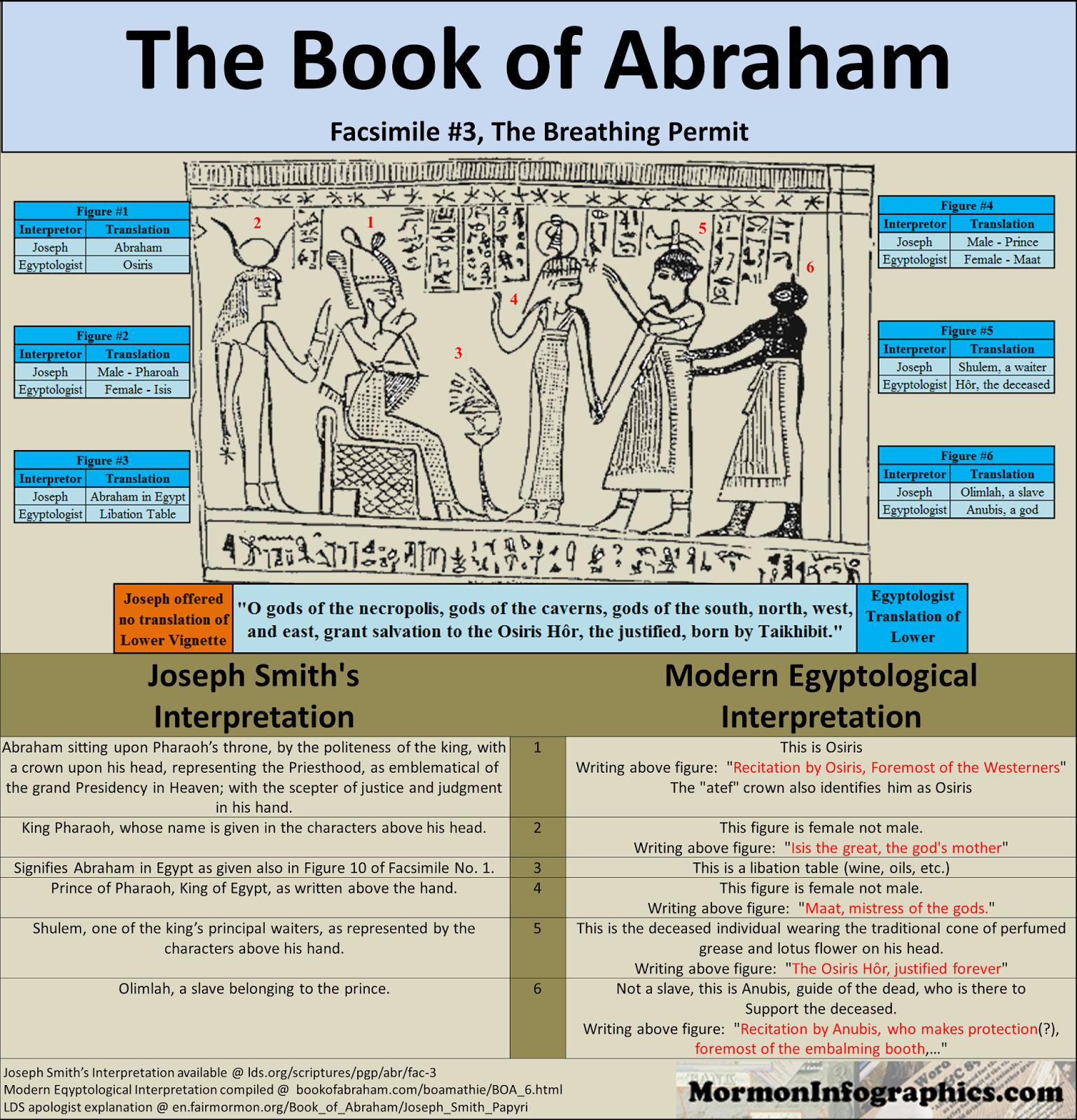
His victory on the "idolatrous god of Pharaoh" is short lived.  The word Pharaoh was a known and even popularized term in the early 19th century.  The Book of Abraham uses the word about a dozen times in the text and another five times in the facsimiles. One could even argue more simply that Joseph Smith ran out of creativity in picking an imagined name of another idolatrous god, so he conveniently went with "Pharaoh" on that last one.  Of the 17 uses of Pharaoh in the BoA, Joseph Smith absolutely incorrectly identifies Pharaoh in Facsimile 3 (item 2) which is not “king Pharaoh”.  The depiction is not only a woman, instead of a man, but it is the goddess Isis, wife of Osiris.  In item 4 of the same, he incorrectly claims the prince of Pharaoh who Egyptologists rightly identify as a woman (again) and the goddess Maat.  The book of Abraham also teaches that Pharaoh and the Egyptians descended from Ham and Canaan (Abraham 1:21-22, 26-27). And that Abraham taught Pharaoh "astronomy" principles that are fodder for jokes at physicist parties.   Not a single Egyptologist or physicist would agree with such claims.  The list of misses goes on and on from there.

So, if Daniel “C” Peterson wants to find a tenuous claim correct in the Book of Abraham involving “idolatrous god of Pharaoh” he should give equal time to all of the many errors Smith made on the matter of Pharaoh.  Errors which are far more clear to see than the dot-linking convoluted path Peterson picks through his cherry tree for the one score he steals.

His parting words are, “those who have been led by the Letter to a CES Director to abandon their faith, should, in my view, reconsider those Mormon claims and the abundant historical support that’s available for them. They simply haven’t studied enough.”

Translation (from a hat): “They simply haven’t cherry picked enough.”


Afterword, with regards to cherry picking. Even Peterson said in his own talk while defending against the Vernal Holley map that, "if you take a long enough list of place names, you’ll find parallels, especially if you’re “loosy-goosy” about it. You’ll find parallels with just about anything. This is easily done. I could show you words that definitely come from Arabic that occur in English, that have no relationship. They’re vaguely similar. They’re totally different definitions. If you have no standards for what counts as evidence, anything could count as evidence."

Exactly, Dan.  NHM, Pharaoh and all that you claim as "really wonderfully strong things" are just what you said--vaguely similar coincidences.  If the claims of the Book of Mormon that you find matched to reality were really more than mere coincidence, scholars the world over would have found them.  Instead, they find, time and time again, the data is almost entirely (and proportionately) against the BoM claims.


Tuesday, August 12, 2014

Attacking the Questioner


The LDS church is at a quandary.  They have attempted in the past to control the information that members will look at when they begin to have questions.  They have subtly attacked the critics, using auxiliary and "unaffiliated organizations" to place doubt in the websites, organizations and critics who bring forward unsavory information about the church.

It hasn't worked. Members are still leaving, as evidenced by the up-swing in talks and conferences geared toward those who doubt.

Now, with insider information at hand, I predict a shift is happening.  Instead of protecting information and attacking the messenger, they will attack the questioner.  Let me review a little and explain this transition.

The LDS church is and has been fond of quoting a few scriptures to tell you that learning can be bad.  

"Ever learning, and never able to come to the knowledge of the truth."(2 Tim. 3:7)


"When they are learned they think they are wise, and they hearken not unto the counsel of God, for they set it aside, supposing they know of themselves, wherefore, their wisdom is foolishness and it profiteth them not. And they shall perish."(2 Ne. 9:28)

These verses suggest that learning should be tempered and controlled by church dictates. The internet made information (and learning) abundant beyond LDS Inc control.  The LDS church's failed attempts to keep members from finding information seems to have peaked in about 2012 or early 2013. For thereafter, they published the essays addressing the same information critics have been reviewing for decades. 

For example consider from October 2012 this  statement:

"Some have immersed themselves in Internet materials that magnify, exaggerate, and, in some cases, invent shortcomings of early Church leaders. Then they draw incorrect conclusions that can affect testimony. Any who have made these choices can repent and be spiritually renewed." Elder Quentin Cook, 6 Oct 2012

October 2012, Apostle Neil Anderson warned: "There have always been a few who want to discredit the Church and to destroy faith. Today they use the Internet. Some of the information about the church, no matter how convincing, is just not true."

Elder Walter Gonzalez declared: "Today, surrounded by so much information, we might think that navigating millions of web pages will give us all that we need to know. We can find good and bad information on the web, but information alone is not enough. God has given us another source for greater knowledge, even knowledge sent from heaven. Our Heavenly Father can give us such knowledge when we navigate the celestial web in our hearts and minds."

Elder Holland clamored against "To those who were once with us but have retreated, preferring to pick and choose a few cultural hors d’oeuvres from the smorgasbord of the Restoration and leave the rest of the feast, I say that I fear you face a lot of long nights and empty nets."

And as another example, President Monson once told the youth:
"Should doubt knock at your doorway, just say to those skeptical, disturbing, rebellious thoughts: ‘I propose to stay with my faith, with the faith of my people. I know that happiness and contentment are there, and I forbid you, agnostic, doubting thoughts, to destroy the house of my faith. I acknowledge that I do not understand the processes of creation, but I accept the fact of it. I grant that I cannot explain the miracles of the Bible, and I do not attempt to do so, but I accept God’s word. I wasn’t with Joseph, but I believe him. My faith did not come to me through science, and I will not permit so-called science to destroy it.’ "

Yes, so-called science...  Because science with all its inventions is just so-called imaginary stuff.

Then in October 2013, Apostle Holland also said to doubting members: "[P]lease don’t hyperventilate if from time to time issues arise that need to be examined, understood, and resolved. They do and they will. In this Church, what we know will always trump what we do not know." 

Apostle Uchtdorf also said (infamously quoted): "doubt your doubts before you doubt your faith."   

However, in that same talk, Dieter did say that it is valid to ask questions: "It’s natural to have questions—the acorn of honest inquiry has often sprouted and matured into a great oak of understanding. There are few members of the Church who, at one time or another, have not wrestled with serious or sensitive questions."

While applauding this statement, I predict this is the last time you will hear this validity of unregulated questioning from LDS sources. Soon enough the call to "proper questions" will be raised in the church at fervent high-pitch.

FAIR and LDS leaders used to have a mantra that "there are no easy answers to the questions members have".  Then it morphed into "you just haven't studied enough."  You see, if you haven't seen the complex answers given in deep archives of FAIR or LDS topic pages, then you are to blame, Brother or Sister.  This "blame the investigator" is currently the standard modus operandi.  

However, a shift will occur, or is occurring, from blaming the member for not already knowing obscure answers, to blaming them for not having reasonable questions. The frontline is moving from answers to questions.  Now LDS members will be told their questions are not always reasonable.

An example of this is given already in an Ensign article to youth teachers.  They tell readers that "controversial questions" are "questions to avoid", and to use "carefully worded questions" because, "some questions invite inspiration" while others, it's implied, cause a loss of the spirit.

To the youth themselves, LDS church magazines tell the youth "how you ask a question can make a huge difference in where it leads you."  It attempts to define "questioning" as not good, and "asking questions" as okay: "When it comes to matters of faith, there can be a pretty big difference between [questioning and asking questions]."  

Questioning is defined as "challenging, disputing, or picking something apart...to find fault and destroy confidence." Whereas, asking questions is dependent on "your attitude and your motive in asking a question."  

Did you see that?  That is, why you ask a question matters as much as what or how you ask it.  Really?  Yes, because you better have the right attitude toward the church before you dare question it or ask questions.

This "attack the questioner" tactic is very clever.

While the above strategy comes from lesser known articles and authors, we may expect to see this approach from top leaders coming soon to conferences near you.  

If the LDS church can control the questions, then the need to control information is lessened.  The members are removed further from knowledge that brings more doubts.  If the member who questions while still being faithful is told they are not fulfilling the commandments by asking the wrong questions, then the LDS church can keep that member from even approaching controversial information (which they no longer can control).

Yes, the tactic is a good one if an organization is worried about the truth of its message.  

Can you imagine the same tactic applied in science?  Can you imagine scientific academies controlling what kinds of questions other scientist should dare to ask?  How would that inhibit discovery and invention?

This is one major difference between science and religion: churches have no laboratories. What I mean is that if a scientist has a clever thought (hypothesis), before he turns it into a belief (theory), he will comb the journals to see if it was already out there and tested. If not tested, he will go to the lab and painstakingly experiment until he has validated or--most often--eliminated the idea. It is in the lab where good ideas and bad ones are sorted out. Churches have no laboratories. Just belief systems. 

Interestingly, while labs are where good ideas and bad ones are sorted out, the LDS church wants to sort good questions from bad ones for you to reinforce their belief system.

Does God really intend his true church to inhibit growth by controlling the very questions members can ask?

A sign that an organization is a cult is traditionally called  "information control".  Here, "those who control the information control the person... any information from outside the cult is considered evil, especially if it is opposing the cult. Members are told not to read it or believe it. Only information supplied by the cult is true." (See http://www.cultwatch.com/howcultswork.html )

In a new book released by LDS owned Deseret Book for Terryl and  Fiona Givens, called "The Crucible of Doubt" the description tells us, "Questioning is not the problem, according to authors Terryl and Fiona Givens...The difficulty arises when questions are based on flawed assumptions or incorrect perceptions, which can 'point us in the wrong direction, misdirect our attention, or constrain the answers we are capable of hearing.' "


T. Givens is fond of quoting German philosopher Hans-Georg Gadamer who said(paraphrased) "to ask a genuine question is to make ourselves vulnerable to risk.  By asking a question genuinely, we follow wherever the question leads."

Givens nor the LDS church want members to actually ask genuine questions that lead to genuine fact.  They want them to ask non-controversial questions that lead to faith.

During May 2013, under the apparent direction of the Church, LDS apologist Terryl Givens and his wife Fiona toured the UK and Ireland giving firesides on the ‘Crucible of Doubt’. It seemed to preface to the upcoming 2014 book and attempt to reframe the battle against the critics.  I predict it could be an outline of upcoming LDS leaders strategy.

Cleverly, the LDS church realizes that it is losing the information control battle, and moving the frontline to controlling the question is seemingly one emerging strategy.  If information control is a sign of a cult bearing negative results, then question control is even more so.  

By their fruits ye shall know them, and see them as a dangerous cult.


Science is complex.  Faith simple.
Science produces understanding and invention.
Faith yields belief.
Belief is essentially just the first step of science.

Friday, August 8, 2014

Family Who Self-empower


The Mormon leaders have listened carefully to these words of Jesus:  
"Think not that I am come to send peace on earth: I came not to send peace, but a sword. For I am come to set a man at variance against his father, and the daughter against her mother, and the daughter in law against her mother in law. And a man’s foes shall be they of his own household. He that loveth father or mother more than me is not worthy of me: and he that loveth son or daughter more than me is not worthy of me." (Matthew 10:34-37 )

The temple is the sword by which Mormons carry out Jesus' teaching that a family divided over belief is unworthy of Him. Yes, temple worthiness is a weapon.

Mormon youth, especially young girls and women are inundated with families-are-forever lessons about being temple worthy and finding a young returned missionary to take to the temple where they are sealed together. A faith-doubting spouse can crush that.  Perhaps not officially, but certainly in the minds of every member.  They know this because almost every Mormon family has an un-tithed sister or excommunicated uncle who paces outside the temple alone while the rest of the adult family recline in plush seats watching the young couple get sealed inside the exclusive LDS temple.  It’s a pay-per-view ordinance and pay-to-play ceremony, where you must prove you're tithed and show your sustaining devotion to all that is Mormon before you can walk past security at the temple doors.

The temple worthiness interview questions your devotion and loyalty to the church leaders, your chastity, honesty, and even your friendships.  The interview asks: 
"Do you support, affiliate with, or agree with any group or individual whose teachings or practices are contrary to or oppose those accepted by the Church of Jesus Christ of Latter-day Saints?" (wording as of at least a decade ago.)

By implication, if you befriend or even dare associate with apostates, you might have to stand with your rebel-uncle or welfare-sister outside the temple while your own daughter is sealed in marriage.

In fact, if you have a family member who is actively engaged in apostate groups, the bishops are instructed, according to one recent edition of the Church Handbook of Instructions in a section entitled, "Members Whose Close Relatives Belong to Apostate Groups" that:
"Bishops and their counselors must take exceptional care when issuing recommends to members whose parents or other close relatives belong to or sympathize with apostate groups. Such members must demonstrate clearly that they repudiate these apostate religious teachings before they may be issued a recommend."

Is this institutionalized shunning?  Is this their way of fulfilling Christ’s words that he came with a sword to divide “daughter against her mother”?  It seems to portray Jesus’ words about a “man’s foes shall be they of his own household.”

When asked by a BBC reporter in 2012 about official shunning, Apostle Jeffery Holland said, "If I had a son or a daughter who left the Church or was alienated or had a problem, I can tell you I would not cut that child out of family life," stated Holland.   He further clarified (~5:20 in above video): "If that is what they believe, it's probably a good thing they leave, because we're not a cult."

Holland fails to understand that not cutting that child out of family but encouraging unbelievers to leave the family church for not agreeing strictly with them does sound very cultish to non-members.  Perhaps not as high-pitched as Amish-shunning, but...  In one breath the apostle wants to claim he wouldn't cut his child out and then says in another it is a good thing that disbelieving members leave because "we're not a cult". 

Today, Friday Aug 8 at 2PM MDT, the FairMormon conference in Provo, UT hosts a panel discussion on “Family members who left”.  LDS church members see family members who do leave as a problem worthy of panel discussions. Never mind that airing family matters in public is distasteful and is well beyond improper boundaries—most LDS members are encouraged by their leadership to use guilt and manipulation for breaking personal boundaries.  But the panel will likely encourage self-victimhood. 

I can just hear some of the dialogue this afternoon; not disimilar to ramblings from a Fast-n-Testimony meeting.  “When I married him, he was the perfect returned missionary,” one woman-panelist says, “but then he read that stuff online and began doubting.  Now I don’t even recognize the man I married.  I fasted and prayed for him.  I went to the temple and put his name on the prayer rolls. But it was no help.” Tears well and a sob catches in her throat as she laments, “Now he openly fights against the church and he lies to our kids.  I fear Satan has such a grip on him that even my own elect children will fall away, too.”  The heartfelt audience raises sympathy for this poor woman who is a victim.  The FAIR panel moderator will ask, “What kind of lies does he tell your children?”  Then begins the litany of "sins" which justify shunning “family members who left”. 

It is not uncommon for Mormons to turn the individual actions of a disbelieving loved-one into a reason to feel victimized.  Because if you leave, you have severed their temple sealing and it affects their own salvation.  This is the doctrine of families are forever, until you begin to have reasonable doubts -- then often families must avoid the apostate and feel victimized because they can no longer be forever with the deceived loved-one.

There once was a couple whose marriage was threatened in part by testimony differences.  Their bishop counseled with them and told the doubting husband, “In the temple you covenant to obey God, while your wife covenants to obey you, her husband, as long as you obey God.  How can I counsel her to stay with you if your relationship with Christ is jeopardized by your doubts of the church?”  

That bishop chained the entire future of the marriage around the ankles of the man’s doubts.  The bishop justified the wife to feel victimized by her husband's concerns, rather than develop healthy willingness to consider the validity of her love’s thoughts.  The woman, who believed the sexist doctrines that her covenant was to a man and not with her God, was also caught in the snare that LDS teachings lay for them both—that it is the Mormon church who controls your marriage, not the partners.

Controlling the marriage and the family is the "political economy" of the invisible line between public and private in Mormon matters.  Who benefits from the fact that family matters are publicly aired by panels or controlled through temple worthiness?  The LDS church itself -- financially, by ensuring compliant and frightened members who will do everything they can to remain temple-active.  And they maintain that line by indirect encouragement of ostracizing family apostates right in the worthiness interview.

It is a typical behavior of those defeated by reason and logic to just attack the messenger. It is probably ridiculous to worry over it; except that Wasatch Front jobs and family status are jeopardized when these apologetic henchmen start their ad-hominem whittling.   Molly Ivins once said, “I have been attacked by Rush Limbaugh on the air, an experience somewhat akin to being gummed by a newt. It doesn't actually hurt, but it leaves you with slimy stuff on your ankle.”  I suppose that’s the worst of it—a slimy after-feeling.  We ex-Mormons are freed from being guilted into sobbing victimhood. It is incredibly self-empowering.

We don't have to encourage our LDS family to leave, but we do hope they become self-empowered.


Do other religions use their temples as swords?


Wednesday, August 6, 2014

Shifting FAIRness and Passing Blame


The LDS Church essays on thorny topics such as polygamy, the book of Abraham, DNA and the Book of Mormon, Mountain Meadows Massacre, etc. has put the official stamp of statements on discussion that previously were left to “unaffiliated” organizations like the apologetic Maxwell Institute (formerly FARMS) and the Foundation for Apologetic Information Research, Inc. (FAIR).  Now that FAIR is receiving heavyweight competition directly from the LDS church history department, where does that leave apologists?

Some would say FAIR are vindicated by the church’s essays.  Given we’ve shown documents that the church funneled money to FAIR through 3rd parties, their unaffiliated status is questionable.  And I would suggest rather than being vindicated by the essays, they are becoming marginalized.  Their job functions will shift.  Already are, in fact.

Starting tomorrow, FAIR holds a two-day “FairMormon” conference in Provo.  The SL Trib writes, “participants will find the same hot-button topics that Mormon apologists have explored in years past — the role of women in the LDS Church, homosexuality, the exclusion of black men from the faith’s all-male priesthood until 1978 and questions about the historicity of the Book of Mormon.  It was, in fact, these issues that prompted a group of Internet-savvy Mormon defenders to launch FAIR, which stands for Foundation for Apologetic Information and Research, in 1997.”

It would sound as though it is business as usual.  However, I predict the tone of the conference will move to focus some extent on ad-hominem attacks of critics and those FAIR deems “enemies” of apologists.  One of the highlighted conference speakers (4:15 on Friday Aug 8) is former FARMS president Daniel C. Peterson, who will allegedly speak on the CES Letter by Jeremy Runnels.  Peterson is known for his hit jobs on controversial members such as John Dehlin (who was recently called in by church disciplinary court) and then urged to resign his position at the Maxwell Institute.  FAIR, however, encourages hit jobs.  Scott Gordon has done so with me, and their website for two years has kept personally critical pages on several editors at Mormonthink.

I predict that some time at the conference will be dedicated to indirectly and directly undermining the character of publicly named critics, rather than respond to the data, history and facts critics uncover and discuss.  The topics they will cover are old-hat and standard these days--BoAbraham, Blacks and Priesthood, DNA, etc.  

Will the conference cover the more recent issues for a change?  For example, would FAIR be willing to discuss the cost of profit ventures like City Creek Mall, the salaries of general authorities and the number of many homes owned by each of the sitting apostles?  Not likely.  Ok, if they will focus on the traditional apologetic topics, will they at least critique the character of past prophets who were racists and who made pugnacious proclamations against mixed-race marriages?  Not as likely as they will criticize the lives of those who have raised the racism, immorality and financial debauchery of past and present LDS authorities.

One of the conference sessions includes a panel (2:00 PM on Friday Aug 8) on “what believing Mormons can do when a loved one loses her or his faith.”  I predict that some of the focus here could include what to do when your “loved one” becomes a critic, and how to dismantle them by character distortion.  We shall see, but watch for the "one guest TBD" panelist.

The shift at FAIR from topics like those of the LDS topic essays to character assassination is perhaps inevitable.  They suffer a form of downsizing their jobs “overseas” to the dark oceans of Church Office halls.  Dark, because the disclosures on profitable business, charitable income, allocation of donations and so forth is held very black.  FAIR doesn’t even know what’s really going on, and so expect them to lose LDS Church support as their mission moves from topical discussions to include more and more character assassinations.

FAIR only has itself to blame for being willing to do the LDS church’s dirty work under the guise of an independent, unaffiliated organization while also receiving some of their funding through third-parties from LDS coffers.  The LDS church doesn’t really want them acknowledged and will continue using them to fire missiles while ignoring them officially.  Unfortunately, the apologists’ jobs are moving overseas, so they are changing hats—black assassin hats.


FAIR metamorphosis, but into what?


Tuesday, July 8, 2014

The Book of fAbricam


This is part one of my rebuttal(s) to the long essay at the LDS Topic site, called "Translation and Historicity of the Book of Abraham".  I am extremely busy at the moment, so please be patient with further responses.  (Part two is now here.)

I follow my earlier format of claims first, and then the facts.

Essay Claim:  “The Church of Jesus Christ of Latter-day Saints embraces the book of Abraham as scripture.”

Facts:  In the beginning line, we have a definitive statement that will likely haunt the LDS Church for decades to come.  They reaffirm the book of Abraham (BoA) is indeed “embraced” as scripture.  Yet, when was the last time they spent much time discussing it in their general conference?  Since I no longer attend, I can’t say for sure, but my intuition tells me they have disregarded it as scripture by omission for a decade.

Essay Claim: “The book originated with Egyptian papyri that Joseph Smith translated beginning in 1835.”

Facts: The claim is that Smith “translated” it but the word translate is never nailed down in definition.   The essay moves from “Joseph Smith claimed no expertise in any language” to “The Lord did not require Joseph Smith to have knowledge of Egyptian.”  They leave it as a mystery how Joseph Smith “translated” the BoA.  They take at his word that he did it by “the gift and power of God” requiring extreme faith because of the facts that have followed over the century and a half since.   At one point later in the essay, they try to compare the process to how Cowdery was supposed to attempt translating the Book of Mormon from a stone in a hat with the plates removed from his possession (see the "Mad Hatter Translation" blog here) and imagine (i.e., study) the plates and translation of them in his mind:

“Neither the Lord nor Joseph Smith explained the process of translation of the book of Abraham, but some insight can be gained from the Lord’s instructions to Joseph regarding translation. In April 1829, Joseph received a revelation for Oliver Cowdery that taught that both intellectual work and revelation were essential to translating sacred records. It was necessary to “study it out in your mind” and then seek spiritual confirmation. Records indicate that Joseph and others studied the papyri and that close observers also believed that the translation came by revelation.” (from the essay)

However, Smith’s (and his scribes) wrote in his own words, specifics about the “translation” process that contradict the latest topic essay, including (emphasis added): 

“I commence the translation of some of the characters or hieroglyphics, and much to our joy found that one of the rolls contained the writings of Abraham.” (History of the Church, Vol. 2, p. 236 – July 1835).


“[July, 1835] -- The remainder of this month I was continually engaged in translating an alphabet to the Book of Abraham, and arranging a grammar of the Egyptian language as practiced by the ancients.” (History of the Church, Vol. 2, p. 238).


“October 1 [, 1835] -- This afternoon labored on the Egyptian alphabet, in company with Brothers O. Cowdery and W. W. Phelps, and during the research, the principles of astronomy as understood by Father Abraham...” (Ibid, p. 286)


“November 17, 1835 -- Exhibited the alphabet of the ancient records, to Mr. Holmes, and some others” (Ibid, p. 316).

“The record of Abraham and Joseph, found with the mummies, is beautifully written upon papyrus, with black, and a small part red, ink or paint, in perfect preservation.” (History of the Church, Vol. 2, p. 348—possibly attributed to Cowdery).

Clearly the writers of the latest topic essay have either ignorantly left out or purposely hid Smith’s own words about the translation process, saying there are no eyewitness to the mysterious process.  Joseph Smith, in whom they place the gift of God said some fairly precise statements about the process.  These words lead us to conclude that at the very least Smith believed he was translating in a usual process through alphabets, grammar and writing upon papyrus.   If he believed he was performing this kind of literal translation from the papyrus written upon by the hand of Abraham then either he was duped by himself or by God as to what was happening.  Either way, this opens some serious questions about trustworthiness in the process and 'translator'.

Essay Claim: “It is likely futile to assess Joseph’s ability to translate papyri when we now have only a fraction of the papyri he had in his possession... Since only fragments survive, it is likely that much of the papyri accessible to Joseph when he translated the book of Abraham is not among these fragments.”

Facts: This statement is very suspect.  They claim that we have only a fraction with only one statement from unnamed “eyewitnesses” who said he saw it unrolled on the floor.  In actuality, the eyewitness (from note 32) is actually a story attributed to Joseph F. Smith.  But this quote is known only from a casual comment by Hugh Nibley, who heard it from Preston Nibley, who heard it from President Smith, who was recalling a time when he was five years old or younger.  Hearsay.  I dare the LDS Church to show us otherwise.

Furthermore other studies have shown that we likely have the larger portion of the papyri.  For example, the following Dialogue (a journal written by scholarly Mormons) article goes into complex mathematical calculations in order to accurately estimate the total length of the original papyri using the recovered papyri and markings on the papyri. This winding analysis indicates how big of a scroll the papyri were originally rolled into when they were put in with the mummies. This way they can estimate how much papyri can possibly be missing from the papyri.  

The scholars using mathematics conclude: 

“...no more than 56 cm of papyrus can be missing from the scroll’s interior.  Shortly after the papyri were recovered by the LDS Church, Klaus Baer estimated the original length of the Hôr scroll to have been 150–155 cm. He arrived at this estimate by comparing the text to other copies of the Document of Breathing, particularly Papyrus Louvre... Baer’s estimate for the length of papyrus missing from the scroll’s interior, starting from the left edge of the innermost extant fragment, is 14+35+0.5+16+0.5=59 cm. This agrees remarkably well with the 56 cm obtained from our winding analysis. … The ultimate success of any existing or future theory will depend on its ability to account for all of the evidence, including the fact that there was simply no room on the papyrus for anything besides the Breathing text.”

The upshot of this is, we have about two-thirds of the completed scroll, of which never mentions Abraham, and whose translation is determined by dozens of scholars as the traditional, well know Egyptian Document of the Breathing.  The missing portion of scroll is very well accounted in missing portion of the traditional Breathing which leads scholars to conclude “the fact that there was simply no room on the papyrus for anything besides the Breathing text.”

When the essay says “fraction” they imply a tiny portion such that the remainder would have the actual source of the BoA. But scholars have mathematically measured the scroll and found this claim wholly wrong.  The LDS Church ignorantly or deliberately leaves this information out of the essay.

Essay Claim: “The loss of a significant portion of the papyri means the relationship of the papyri to the published text cannot be settled conclusively by reference to the papyri.”

Facts: Bullshit. And they know it.  They contradicted themselves elsewhere in their own essay.  Quote: "The fragments included one vignette, or illustration, that appears in the book of Abraham as facsimile 1."  They claim first we cannot test the translation because we have none of the actual fragments Smith used.  Then they claim it is "included" and "appears" in the BoA fascimile 1 (and we know #2 and #3 as well).

 We have literal translations of each facsimile which are printed in every copy of the BoA in the Pearl of Great Price.  If Smith translated these directly, as the notations provide in each member’s copy, and they almost entirely do not match scholarly translations, then the essay is wrong.  We can test the translation against the published text because a direct relationship between them exists. 

To wit, I will use Bart Pascoal’s wonderful infographics to illustrate:


Click on each above graphic to read the small text in larger size.  For an extremely thorough discussion of these and more issues about the book of Abraham, please visit this Mormonthink page


The upshot is, Smith attempted to claim he was translating directly from the characters on the pictorials of the facsimiles.  This direct relationship to the text (found in the surviving 2/3rds of papyri) show a complete failure at translating.  How then can one have faith that the rest of the text is correct?  Furthermore, if it’s shown with little doubt that Joseph Smith could not translate regular Egyptian in the papyri we do have, then how can we trust he translated something called “reformed Egyptian” on gold plates we don’t have?

The case of the Book of Abraham is tied to the authenticity of the Book of Mormon.  The essay writers plainly said so when they compared the translation methods between the two (quoted above) and left Smith hung out to dry.  He couldn’t translate Egyptian, reformed Egyptian or anything else except his own imagination.


Friday, July 4, 2014

The Founding Fathers Would Jeer at Utah on this 4th


In past 4th's of July I would've wanted to raise a respectable mug of homemade root beer to the Doctrine and Covenants for giving me a civics lesson.  Discussing religious freedom and liberty, it reads in Section 101, verse 80:  
"I [the Lord] established the Constitution of this land, by the hands of wise men whom I raised up unto this very purpose..."

God said he raised up wise men to establish the constitution, so that "every man may act in doctrine and principle pertaining to futurity, according to the moral agency." (v. 78)

What were the morals, doctrines and principles of these wise men of Constitution establishment? 

According to Kevin Bleyer at the Daily Beast:  
"Our Constitution was written by men who owned breweries and imported whiskey—fine businesses both—but also imbibed those products to an astounding degree, and then humped cows in the streets. The amount of staggering was staggering."  (Life, Liberty and the Founding Father's Pursuit of Hoppiness)

Many of us have heard several of the founders had problems keeping it in their pants. In the book, The Intimate Lives of the Founding Fathers, author Thomas Fleming details infidelities by George Washington, Ben Franklin, John Adams, Thomas Jefferson, Alexander Hamilton, and James Madison.  Franklin, for example, led a polygamous life with  two "wives," -- one in London and one in Philadelphia. Washington carried a secret with Sally Cary Fairfax behind Martha's back. Hamilton and Jefferson had adulterous relationships, the latter with his black slave Sally Hemings.

What some of you may not have known are the excesses in drinking that raged at Constitutional Hall.  Bleyer states there is evidence that:
 "Almost all the Framers imbibed. Most didn’t just drink beer...the fact remains, they drank beer for breakfast. While writing the Constitution.  Don’t believe any claims they weren’t binge-drinkers and were just letting off a little steam—again, and I can’t stress this enough, they did so while delicately crafting our basic system of laws. After they finished the four months of drunken civic-mindedness, the 55 men who were about to sign the document piled into Philadelphia’s City Tavern on Friday, September 14, 1787 and guzzled enough booze to fell a stack of elephants: 60 bottles of claret, 54 bottles of Madeira, 50 bottles of “old stock,” vats of porter, cider, and beer, and what has been described as “some” bowls of rum punch. So raucous did the celebration get that City Tavern took the unusual step of sending along a bill for “breakage.” "

When God said he raised wise men for the purpose of framing the US Constitution, I think of God winking at us to raise a pint to and with the writers.  These guys would outdo most frat parties, by the sound of it.  Perhaps God likes him some partying.

So celebrate your 4th of July like the founders did if you will.  It's okay if you Mormons raise a mug of root beer, but the framers would laugh at you.

“The Government of the United States of America is not in any sense founded on the Christian religion.” 
--1797 Treaty of Tripoli signed by Founding Father John Adams


Thursday, July 3, 2014

$4+ Billion Free in Labor

Veilware--the new product of Wallstreet. 

Recently, the Deseret News accounted the LDS missionary sales force to peak at 88,000 missionaries. These missionaries work labor-free, at least 50 hours (more likely 60-80 hours) per week when you include weekends.  The larger percent of them pay for their own living costs, to the tune of (I believe) $450 per month, and are now asked, according to the Dnews, to pay for their own iPads at $400 each.

That's 88,000 missionaries working 50+ hours per week -- a total of 228,800,000 hours of free annual labor.

It's interesting that the DNews article mentioned iPads.  In 2012 I compared the LDS Corporation with Apple Inc, concluding that:  "LDSinc is a mind-boggling large, enormously well-fed, tax-exempt privately held company that seems to dwarf Apple Computer. "

I gave more numbers in that 2012 blog to show that, financially, LDS corp has asset holdings and liquid cash estimated to rival Apple Inc.  What the LDS corporation has that Apple doesn't shouldn't surprise you:  LDS Inc has $4+ Billion in free sales-force labor, if you consider each salesman is about the same age and competency as an Apple Inc store salesman.

How did I get that $4 Billion number?

...88,000 missionaries
x 50 hours per week
x 52 weeks per year
x 2 years per mission
x $10/hour wage
-----
$4,576,000,000

Each of these missionaries is hoping to hook new converts that will donate 10% of their lifetime income to the LDS corporation. In the USA, per convert that could total six-figures of donations over a couple decades, not to mention free labor of service by cleaning buildings, selling the gospel for free to new converts and counting the monies in the ward clerk offices.  Missionary free labor is still just a drop in the multi-billion dollar bucket when you include all the time individual members give to the promotion and up-keep of the LDS corporation.   

Apple wets their collective pants wishing for so much revenue per new customer with all the donated free labor.  They might net a few thousand dollars in sold products.  Tangible products that the customer can actually hold in their secular hands.  LDS products?  Mostly beyond the vaporous veil.

An insider at the COB has recently recounted to me that the LDS Corporation has about $15 Billion in liquid cash, not tied in assets, companies or properties.  That's a lot of cash to purchase new assets.  And they have mostly free labor to provide accounting and upkeep on the ecclesiastical (or sales) arm of the corporation.

Labor is the most expensive outlay for most corporations that produce tangible products.  For a corporation selling vaporous veilware, its labor is ... well, it's free.  They have nearly zero raw materials to buy in producing their doctrinal product.  And they pay no taxes on the promotion, sales and donations received for their veilware.

So where does all the money go?

The old Ogden Temple, torn down because it wasn't pretty enough.  Where does that money go?